
Prairie Ark: A UFO on the Mongolian Steppe That Tries to Disappear Into the Landscape
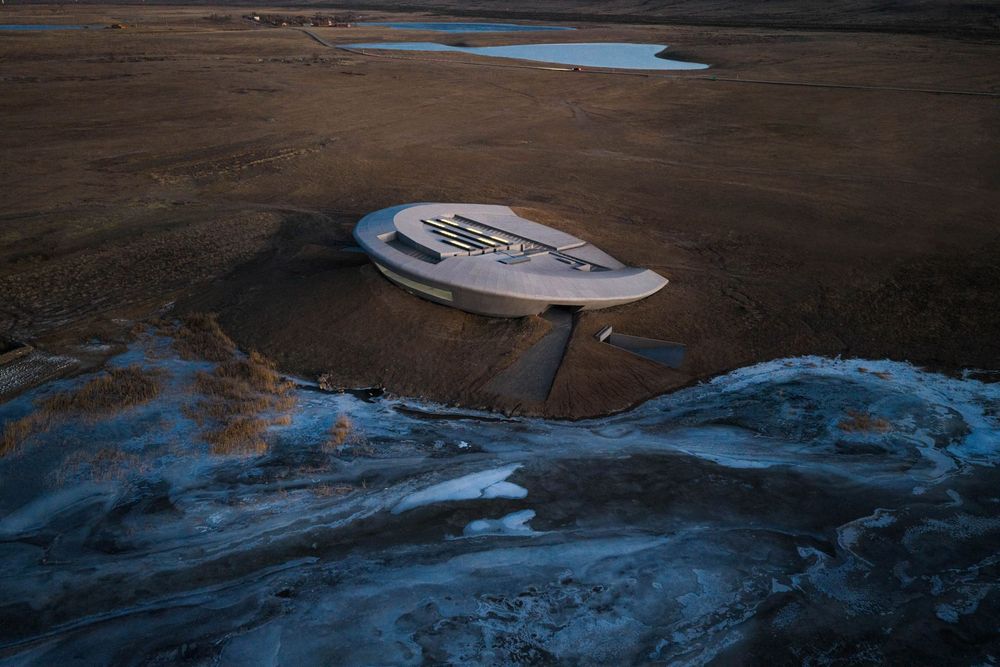
A building resembling a crashed spacecraft has emerged on the vast grasslands of Inner Mongolia. Prairie Ark is not a futuristic manifesto, however. It is a precisely designed attempt to blur the boundary between architecture and landscape.
At first glance, Prairie Ark looks like an object from another planet. The flattened, almost circular structure sits in the grassland beside Laoli Lake in Ulanqab, Inner Mongolia. Its distinctive form makes it almost impossible to mistake for anything else.Yet creating an architectural icon was not the project's primary goal. Designed by BUZZ / Büro Ziyu Zhuang, the building was conceived to establish a strong relationship with its surroundings. Rather than copying traditional Mongolian architecture, the architects treated the landscape itself as the project's primary design material.
A Building Embedded in the Landscape
Prairie Ark is partially embedded in the ground. Its low profile and broad, flattened form allow it to almost disappear against the vast steppe. The most intriguing element is the roof. Rather than creating a clear boundary between the building and its surroundings, it extends into slopes and terraces. Visitors can walk across it, while entrances are positioned at different levels.
The architecture has not simply been placed on the site. It has been integrated into the terrain.
This approach also has a symbolic dimension. In a landscape shaped by nomadic culture, the building does not attempt to impose a single dominant landmark. Instead, it allows visitors to experience the architecture much like the landscape itself — through movement, changing levels, natural light and views.
An Interior Without a Fixed Scenario
Inside, the project features a large, open space without a rigid division into separate rooms. It can function as a gallery, exhibition venue, cultural event space, performance venue or meeting place. Programmatic flexibility is just as important here as the building's distinctive form. The architects deliberately avoided creating architecture dedicated to one specific use. Prairie Ark is designed as a space whose character can evolve with its users.
Natural light also plays a central role. A series of skylights across the roof brings daylight deep into the interior, creating an atmosphere that changes throughout the day. Architecture is therefore not experienced solely as form. It becomes an experience of light, shadow and time.
Materials Designed to Age
The project uses raw materials whose colours and textures relate to the surrounding terrain. Their ageing is not treated as something to conceal. On the contrary, traces of rain, wind, sunlight and time are expected to gradually integrate the building even more deeply into its surroundings. This approach reinforces one of Prairie Ark's central ideas: the building should not remain an unchanged object placed in nature. It should evolve with it.
The Other Pole: Nomads' Beacon Tower
The composition is completed by Nomads' Beacon Tower, located on a small island in Laoli Lake. Unlike Prairie Ark, the tower does not attempt to disappear. It is tall, vertical and visible from a considerable distance. Its form references historic signal towers, structures that once served as landmarks and points of orientation across vast landscapes.
The tilted concrete structure reaches towards the lake, creating the impression that the massive volume is hovering above the ground. At the top, a viewing platform offers panoramic views across the water and surrounding grasslands. If Prairie Ark is architecture embedded in the landscape, the tower becomes its landmark.
Architecture Between Earth and Sky
The strength of the entire complex lies in this contrast. Prairie Ark is horizontal, low and connected to the ground. Nomads' Beacon Tower is vertical, exposed and directed towards the sky. One structure tries to disappear. The other wants to be seen.
Together, they create a new cultural destination beside Laoli Lake — a place where architecture does not compete with the scale of the Mongolian landscape, but instead makes that scale part of its own composition. And this is why the word “UFO” is only the starting point when describing Prairie Ark.
The most fascinating thing about the project is not that it looks like a spacecraft. It is that everything about it is designed to eventually make it feel like part of the earth.
Project Credits
Project: Prairie Ark and Nomads' Beacon Tower
Location: Ulanqab, Inner Mongolia, China
Architects: BUZZ / Büro Ziyu Zhuang
Area: 1,360 m²
Year: 2025
Photography: Shengliang Su, Wei Wei, Banye Lin, Wushengqidi